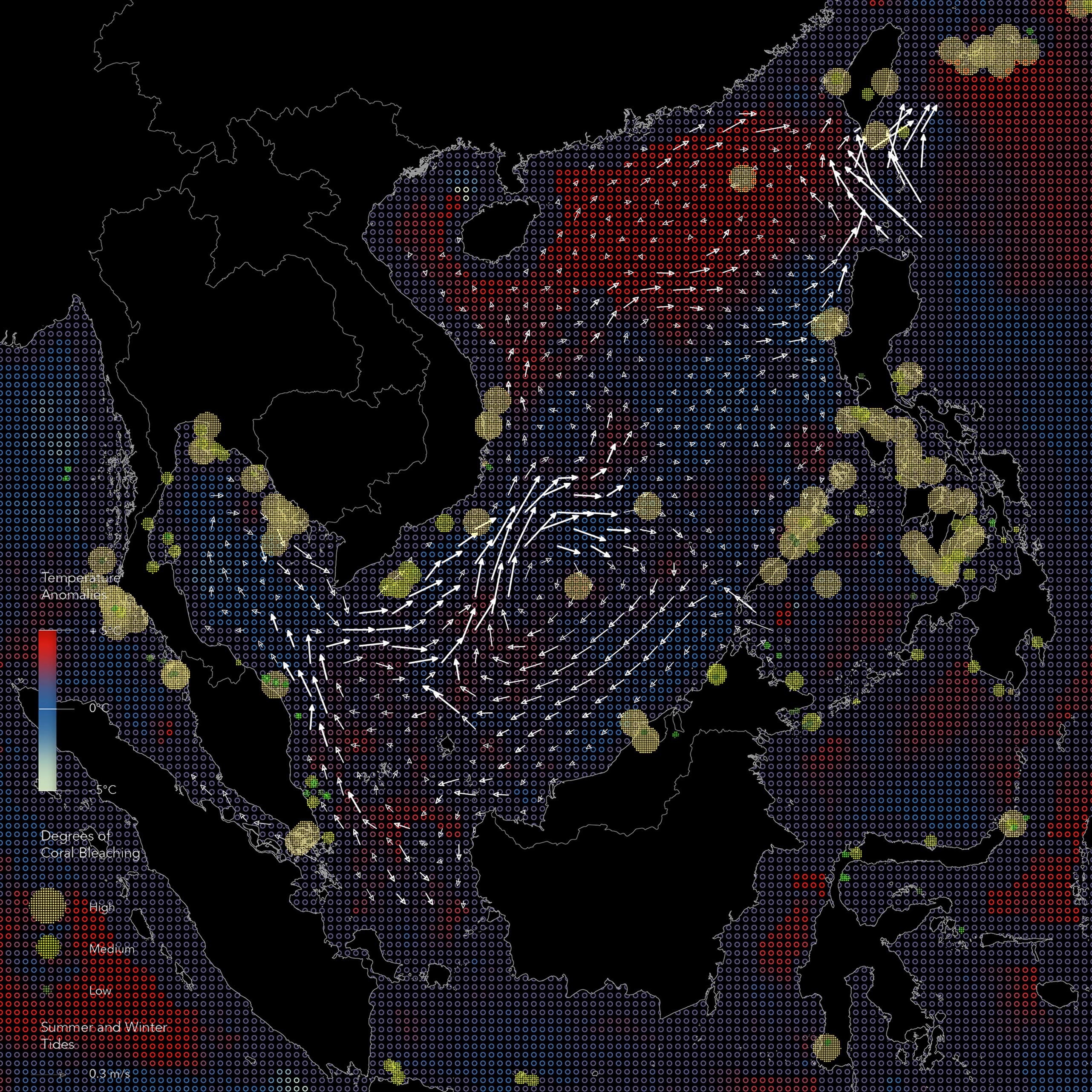
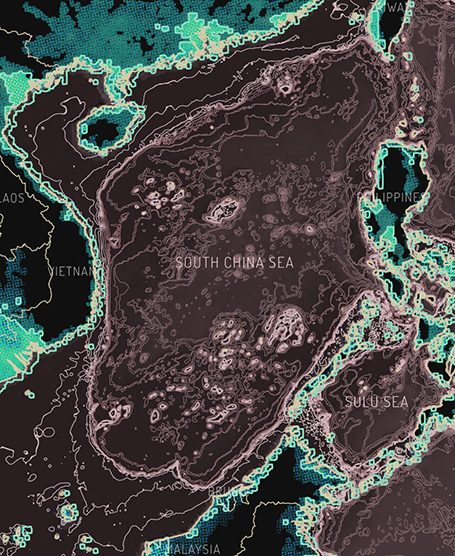
The studio takes on the challenging task of rethinking the area the circles around “South China Sea”, its geopolitical and material ecology through the reconceptualization and design of large scale infrastructures and localized-material assemblages.
The South China Sea is the central core of our testing ground, an area that has multiple designations given by the various sovereignties that claim it. Its boundaries arise amidst the shorelines of China, Taiwan, the Philippines, Malaysia, Brunei, Indonesia, Singapore and Vietnam. Within its 3,500,000 square kilometers it contains no more than 15 square kilometers of land distributed within no less than 250 islands, atolls, cays, shoals, reefs, and sandbars; some seasonally submerged, others permanently underwater; some in continuous state of mutation, growing, solidifying. The SCS carries a tremendous strategic importance owned to the fact that one-third of the world’s shipping passes through it carrying over $3 trillion in trade each year; it contains fisheries that are crucial for the food security of millions in Southeast Asia and, it has huge oil and gas reserves -believed to lie beneath its seabed.
Site_Issues: Environmental issues: perennial disputes among 6 countries over its ownership; huge environmental impact of dredging activity of site, destruction of coral reefs on site; subduction + low salinity of the water; weakened buffering capacity to strong typhoons. Geopolitical issues: being one of the most important slocs in the seas on the one hand, and given the ambiguity of both, its morphological thresholds and masses dusting its waters on the other, this site has been subject of historical disputes over its sovereignty. These disputes are increasingly becoming one of Asia’s most potentially dangerous point of conflict, one with a political domino effect that could surpass by large the immediate region, creating new territorial alliances and hierarchies within the worldwide power structures.
[Meta-Fiction and Ecology]
We will read the (in)tangible lines drawn by geology, energy (resources) and politics and map the invisible, describe the submerged, uncover the concealed … in doing so we will design a future: the fictional context within which these precious square kilometres are contained. Among many possible scenarios based on the hastening events taking place now, ours will choose to be situated within the polemic, evidencing the studio’s provocation. The studio will develop alternative para-consistent realities, fiction, because as Kim Stanley Robinson writes, “science fiction is the realism of our time”
Designers are in this course strategists, writers, conceptual and morphological explorers. Influences of the lab are the politically driven manifestos (such as that of the Russian Cosmists… recently of the “Xeno-femminist”, the “Accelerationist”…), “hyperstitional” narratives able to re-invent the present, by having the courage to reimagine-and-live right here and now, the possibility of an-Other future. To design in the course is to map and bring out layers of “controversies”, to form an alternative milieu whence a new reality could germinate. What emerges at the end of the course, we hope, are works that are politicized at core, designs that have the courage to look onto post-hyper-anthropocentric scenarios and that give now hopes to one primary mission: liberating thought from the enslaving forces that makes it a victim of its own incapacities, and with such liberation imaging new forms of living together on earth, and possibly in a future, in one of its distant horizons.